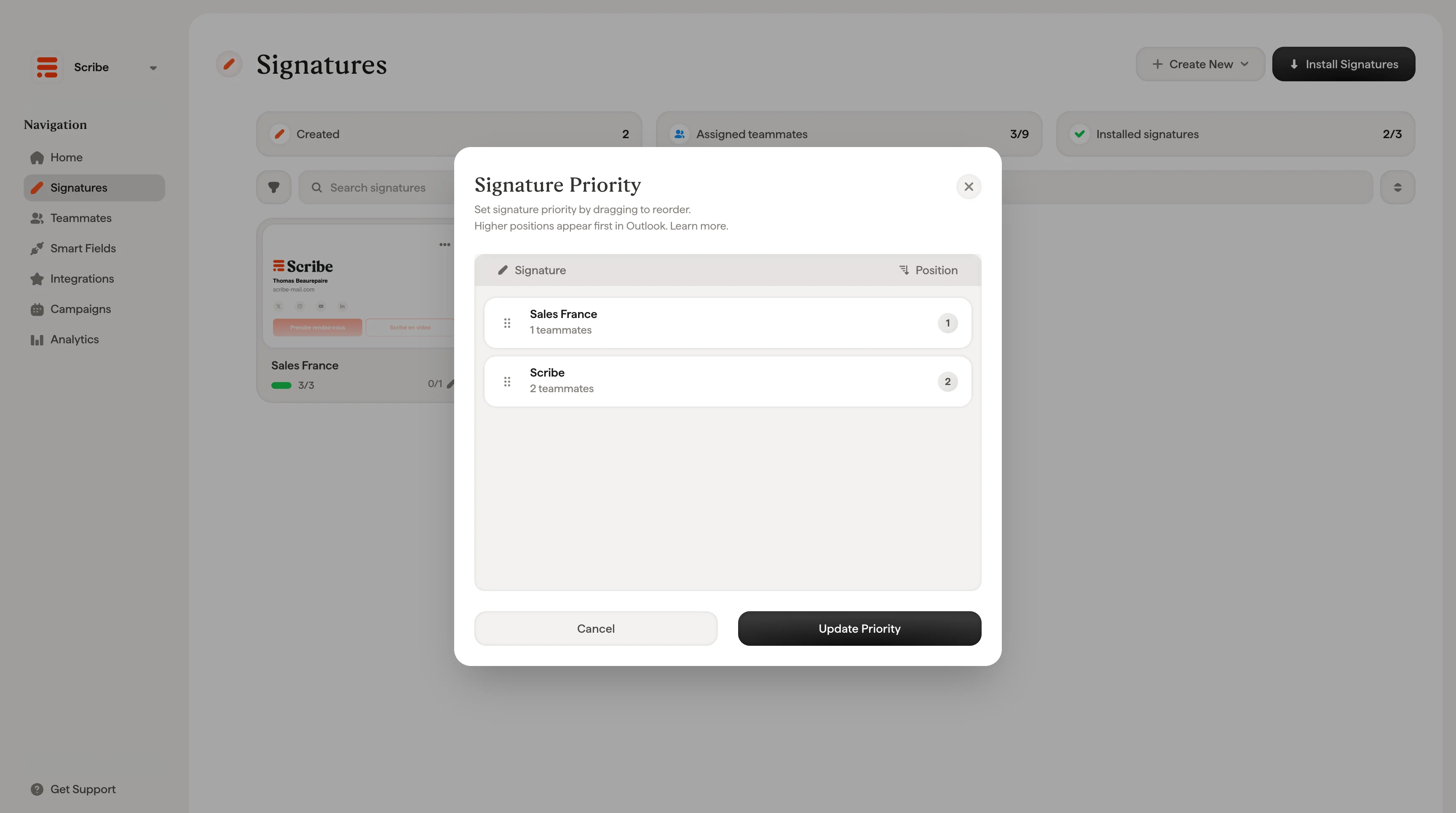
# Signature priority list

## Understanding Signature Priority in Gmail or Outlook

<figure><img src="/files/l5BQ6lLOjMSIx44MmDE5" alt=""><figcaption></figcaption></figure>

### How Signature Priority Works

When you have multiple email signatures configured in your Gmail or Outlook account through Scribe, the order of these signatures determines how they appear in your email client. Here's what you need to know:

### Key Points

* The order of signatures in the list determines their priority.
* Signatures at the top of the list take precedence over those below.
* You can easily change signature priority by dragging and reordering them.
* Changes in priority affect how signatures are inserted in your emails.

### Managing Signature Priority

1. Accessing the priority list:
   * Navigate to the Signatures section
   * View your list of signature templates
2. Changing priority:
   * Click and hold a signature template
   * Drag it up or down to change its position
   * Release to set the new priority
3. Best practices:
   * Place your most frequently used signature at the top
   * Organize department or team-specific signatures in a logical order
   * Review and adjust priorities as needed

### Impact on Email Composition

Understanding how priority affects your email signatures helps ensure the correct signature is used in your communications. The signature order you set determines which signature template your email client will use by default when composing new emails.


---

# Agent Instructions: Querying This Documentation

If you need additional information that is not directly available in this page, you can query the documentation dynamically by asking a question.

Perform an HTTP GET request on the current page URL with the `ask` query parameter:

```
GET https://help.scribe-mail.com/scribe/signature-templates/signature-priority-list.md?ask=<question>
```

The question should be specific, self-contained, and written in natural language.
The response will contain a direct answer to the question and relevant excerpts and sources from the documentation.

Use this mechanism when the answer is not explicitly present in the current page, you need clarification or additional context, or you want to retrieve related documentation sections.